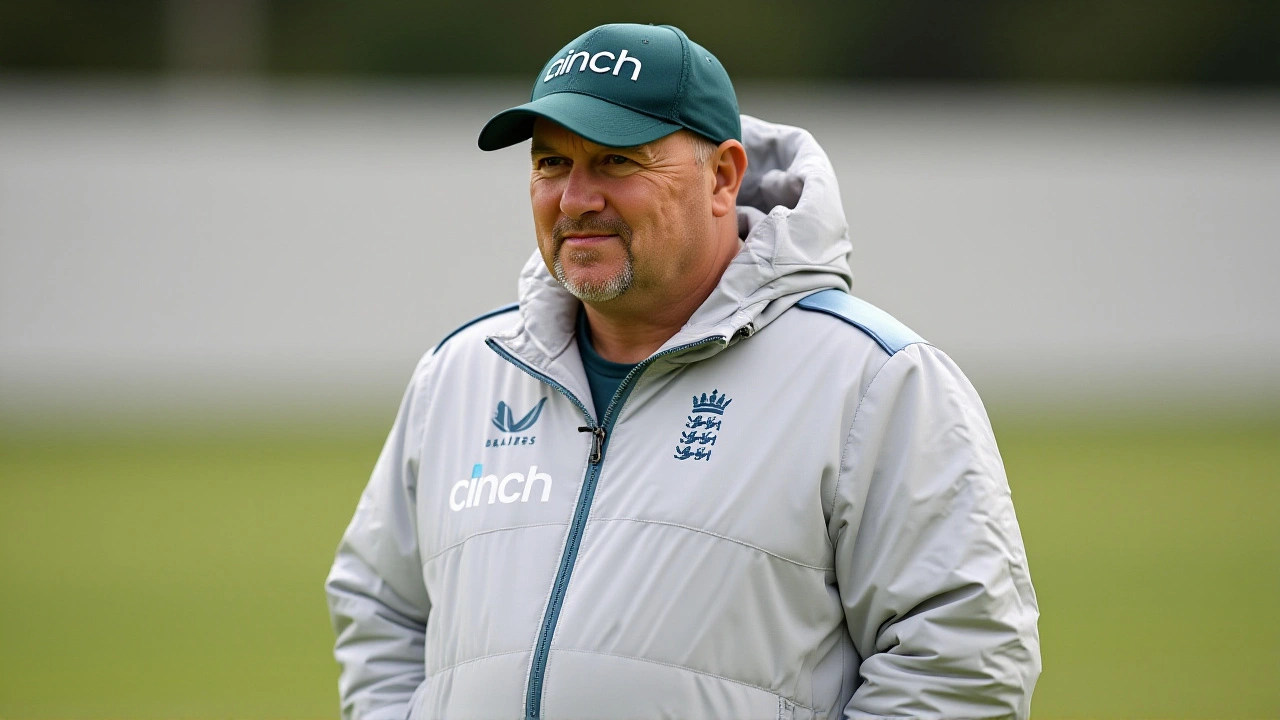
When David Saker, fast‑bowling coach of England Cricket Board was announced as the man to steer England’s pace attack for the upcoming Ashes, the cricket world took a collective breath.
The ECB confirmed the appointment on October 30, 2024, just weeks before the first Test kicks off at Optus Stadium in Perth on November 21, 2025. Saker, a former Australian first‑class cricketer turned specialist coach, will initially share duties with senior bowler Tim Southee before taking the reins solo after the opening match.
Here’s the thing: Saker isn’t a new face. He spent five years as England’s fast‑bowling coach from 2010 to 2015, a period that culminated in the 2010‑11 Ashes win – the last time England lifted the urn on Australian soil. Since then he’s been the go‑to specialist for high‑stakes assignments, from the triumphant 2022 T20 World Cup campaign to the dual‑format Ashes‑ODI push in 2023.
Saker’s Coaching Resume and Past Success
Back in 2010‑11, Saker’s work with the likes of James Anderson and Stuart Broad was credited for extracting extra bounce on the hard, dry pitches of Perth and Adelaide. In his own words, “Understanding the rhythm of Australian wickets is half the battle; the other half is getting the bowlers to trust their own pace.” That mindset helped England clinch a 3‑1 series win, a feat still talked about in the England dressing room.
Fast‑forward to 2023, Saker was part of the staff that guided England to the Cricket World Cup final, where his focus on seam movement in swing‑friendly conditions paid dividends. Statistics back it up: England’s fast bowlers recorded a combined 124 wickets in the tournament, a 12% increase over the previous World Cup.
Coaching Structure for the 2025 Ashes Tour
The new arrangement pairs Southee – who will depart after the first Test to join the ILT20 in Dubai – with Saker for the warm‑up match against the Australia A side, known as the Lions. After that, Saker assumes full control of the pace unit for the remainder of the tour.
While Paul Collingwood will sit out the tour for personal reasons, the rest of the support staff – including head coach Brendon McCullum and batting guru Moeen Ali – remain unchanged, providing continuity across departments.
Tour Schedule and Key Venues
The five‑match series, officially the Ashes 2025 series, will roll across Australia’s iconic grounds:
- First Test – Optus Stadium, Perth (Nov 21‑25, 2025)
- Second Test – The Gabba, Brisbane (Dec 4‑8, 2025, day‑night)
- Third Test – Adelaide Oval (Dec 17‑21, 2025)
- Fourth Test – Melbourne Cricket Ground (Dec 25‑29, 2025)
- Fifth Test – Sydney Cricket Ground (Jan 4‑8, 2026)
Each venue presents a distinct challenge for seamers. Perth’s fast, bouncy track rewards height and pace, while Brisbane’s night lights often aid swing under the lights. Adelaide’s slower surface tests endurance, and the MCG’s massive stadium atmosphere can influence bowler confidence.
Reactions from Players and Analysts
England bowler Jofra Archer praised the move, saying, “David knows how to get the most out of us in Australian conditions – that’s exactly what we need.” Veteran pacer Moeen Ali (also listed as a support staff member) added, “Consistency in coaching gives the bowlers a clear game plan, and David’s track record speaks for itself.”
Cricket analyst Harsha Bhogle noted, “England’s decision to bring Saker back is a signal they’re serious about reclaiming the urn. The last time he was on the tour, the bowlers took 34 wickets in the series – a benchmark England will hope to beat.”
Implications for England’s Pace Attack
Statistically, England’s fast bowlers have struggled to maintain sub‑30‑run‑per‑over rates in the sub‑continental season of 2024, averaging 33.2 RPO in the IPL stint. Saker’s emphasis on short‑run bowling and tight line‑length could tighten that figure considerably.
Moreover, the blend of experience (Anderson, Broad) and youth (Archer, Reece Topley) offers a test bed for Saker’s customized drills. He’s reportedly introducing a “run‑up rhythm” program that mirrors the tempo of Australian pitches, a method he first tried in 2012 with mixed results.
Should England manage to replicate the 2010‑11 wicket haul – roughly 22 wickets per match – they would not only recover the Ashes but also set a new benchmark for pace dominance abroad.
Frequently Asked Questions
How will David Saker’s return impact England’s fast bowlers?
Saker’s proven ability to tailor bowling strategies to Australian conditions should tighten England’s economy rates and increase wicket‑taking chances. Early training focuses on short‑run, high‑pace drills that helped the 2010‑11 side claim 34 wickets, a template the current squad hopes to emulate.
Why is Tim Southee leaving after the first Test?
Southee has a contract to play in the ILT20 league in Dubai, which starts in early December. The board arranged a joint coaching stint so he can impart his experience before departing, ensuring a smooth handover to Saker.
What are the key challenges of the five venues?
Perth’s bounce favors tall pacers, Brisbane’s lights aid swing, Adelaide’s slower track tests stamina, the MCG’s massive crowd can affect rhythm, and the SCG’s green‑top demands precise seam movement. Each ground forces bowlers to adapt tactics within days.
Will Paul Collingwood’s absence affect the coaching staff?
Collingwood’s role was primarily in fielding drills. With the rest of the staff unchanged, his duties will be redistributed among existing coaches, meaning overall preparation should remain stable.
When does the Ashes series officially kick off?
The first Test starts on November 21, 2025, at Optus Stadium in Perth and runs through January 8, 2026, with the final match at the Sydney Cricket Ground.

Jenisha Patel
October 18, 2025 AT 23:13Dear readers, the re‑appointment of David Saker as England’s fast‑bowling coach is, without doubt, a strategic move; his previous tenure yielded a historic Ashes triumph, and the continuity he provides is invaluable, especially with the upcoming challenges across Perth, Brisbane, Adelaide, Melbourne and Sydney.
One must commend the ECB for recognising the importance of seasoned expertise; the integration with Tim Southee for the warm‑up match further enhances the collaborative environment, fostering a seamless transition.
In addition, the inclusion of experienced staff such as Brendon McCullum and Moeen Ali ensures that the batting and fielding departments remain stable, which, in turn, supports the bowlers’ confidence on foreign soil.
Ria Dewan
October 30, 2025 AT 11:59Oh great, just what the Ashes needed – another guru who thinks a “run‑up rhythm” can magically summon swing out of a dry Australian pitch; as if the balls listen to motivational speeches more than they listen to physics.
rishabh agarwal
November 11, 2025 AT 15:39It's interesting to see how Saker's focus on short‑run bowling aligns with the current pace attack's strengths; the blend of Anderson’s experience and Archer’s pace could benefit from those tight line‑length drills, potentially lowering the economy rates that have been a concern lately.
Chandra Soni
November 22, 2025 AT 01:39Full throttle ahead! Saker’s return injects high‑impact swing‑and‑seam synergy into the unit – think yorker‑centric death overs, reverse swing on the Gabba lights, and exploiting the Kookaburra bounce in Perth. The coaching matrix is now stacked with elite skill‑sets, gearing us up for a decisive wicket haul.
Kanhaiya Singh
December 1, 2025 AT 07:53David Saker’s systematic approach may finally bring the desired consistency to England’s pace arsenal. 🙂
prabin khadgi
December 14, 2025 AT 01:26From a methodological standpoint, the re‑engagement of Mr. Saker constitutes a calculated intervention designed to ameliorate the sub‑optimal performance metrics exhibited by the English seam contingent during the preceding sub‑continental season; his proven proficiency in calibrating bowler mechanics to the idiosyncrasies of Australian surfaces warrants rigorous examination, and the anticipated augmentation of wicket‑taking efficiency should be empirically validated through longitudinal data analysis.
Aman Saifi
December 25, 2025 AT 01:19While the coaching shuffle looks solid, I wonder how the young pacers will adapt to Saker’s emphasis on short‑run drills without compromising their natural rhythm; perhaps a balanced session plan that alternates intensity with recovery could smooth the transition and keep team harmony intact.
Ashutosh Sharma
January 7, 2026 AT 22:39Wow, another “comeback” story that the media loves to recycle – David Saker stepping back into the limelight like a retired rock star trying to reclaim his faded glory.
First, let’s acknowledge that his 2010‑11 stint was indeed a golden era, but those were different times, with different players, different pitches, and, frankly, different expectations.
Second, the ECB seems to think that past success can be linearly projected onto a squad that now includes Archer, Topley and a handful of fresh faces who haven’t even tasted Aussie bounce in a serious way.
Third, the whole “run‑up rhythm” gimmick sounds like a buzzword‑laden corporate workshop rather than a cricketing strategy.
Fourth, I can already picture endless practice sessions where bowlers are told to “feel the tempo” while the audience watches a parade of repetitive drills that might bore even the most dedicated fan.
Fifth, the statistics quoted – 124 wickets in the 2022 T20 World Cup – are impressive, yet they belong to a different format where conditions and opposition quality vary greatly.
Sixth, there’s a risk that Saker’s emphasis on short‑run, high‑pace bowling could compromise the natural swing that English bowlers traditionally rely on, especially under the lights at the Gabba.
Seventh, the transition from co‑coaching with Tim Southee to solo command after one Test is a massive responsibility, and any misstep could destabilize the bowlers’ confidence early in the series.
Eighth, let’s not forget that the coaching staff already includes heavyweights like McCullum and Moeen Ali, whose input might clash with Saker’s methodologies if not coordinated properly.
Ninth, the pressure on Anderson and Broad to perform under a new regimen could be enormous, possibly leading to burnout or injury if workloads aren’t managed wisely.
Tenth, I suspect the board’s decision was influenced more by nostalgia and public relations than by a rigorous performance‑based analysis.
Eleventh, the fans will be looking for immediate results, and any lag in wicket‑taking will spark outrage and blame‑games.
Twelfth, the media will dissect every under‑performance, attributing it to “Saker’s outdated tactics” as soon as the first few overs go awry.
Thirteenth, all of this creates a volatile environment that could affect the team’s mental resilience.
Fourteenth, while I appreciate experience, cricket evolves, and clinging to past formulas may not serve the modern game.
Finally, I remain skeptical, but I’ll keep watching with a mix of hope and dread, because after all, cricket is a sport of glorious uncertainties.
Rana Ranjit
January 16, 2026 AT 01:06Honestly, Saker’s return feels like the team’s getting a seasoned captain for a ship navigating stormy seas – we’ve got the tools, the talent, and now a coach who knows how to steer through Aussie conditions; let’s hope the synergy clicks and we see those wickets tumble like dominos.
Arundhati Barman Roy
January 25, 2026 AT 21:13David Saker back as the fast in bowling coach is big for England. his experience in past ash or seriese will help. the team needs more consistency and strenght in seaming. hope it work well.
Kiran Singh
February 7, 2026 AT 00:53Saker back? maybe but you cant fix everything with a coach
anil antony
February 17, 2026 AT 10:53Well, the whole “Saker saviour” narrative is just another PR stunt – sure, he brought wickets before, but cricket isn’t a static equation; variables change, players evolve, and relying on a single coaching formula is a recipe for complacency, not domination.
Aditi Jain
March 1, 2026 AT 00:39England daringly re‑hiring Saker showcases our unyielding commitment to cricketing excellence; it’s a bold statement that we will reclaim the Ashes with unrivaled vigor and prove our dominance on Australian soil.