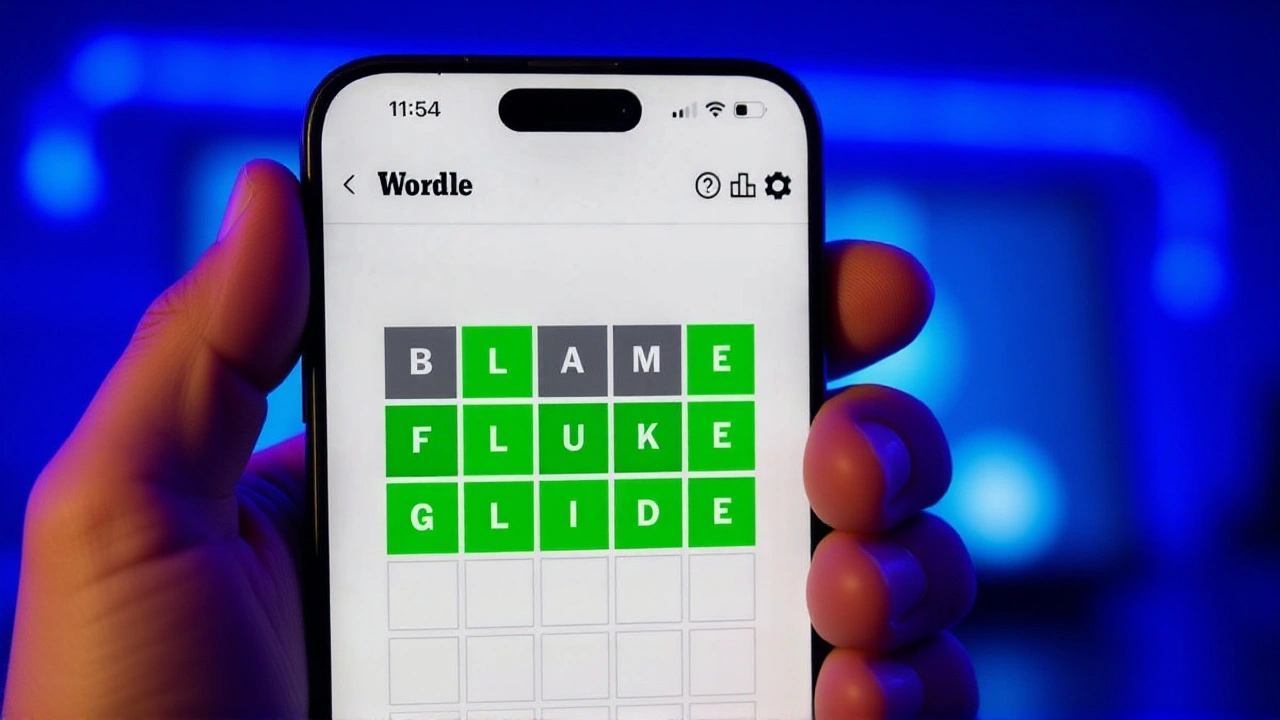
On Thursday, December 4, 2025, millions of Wordle players around the world breathed a sigh of relief — or maybe a groan — as the daily puzzle revealed its answer: TULIP. The New York Times’ beloved word game, The New York Times Wordle, delivered puzzle #1629 with a deceptively simple solution that turned out to be one of the most straightforward of the year. By 3:34 PM UTC, PC Guide, a reader-supported tech news outlet known for its daily Wordle breakdowns, confirmed the answer after the global puzzle window had opened at midnight local time in every time zone. What made this day special wasn’t just the word itself, but how perfectly it fit Wordle’s signature blend of accessibility and challenge.
What Made TULIP So Easy — And So Perfect
TULIP, the answer to puzzle #1629, is a five-letter word with exactly two vowels (U and I), no repeated letters, and a meaning familiar to nearly everyone. It’s a flower. A common one. A colorful one. A word you might see in a garden, on a Valentine’s card, or even in a child’s drawing. That’s exactly why PC Guide described it as "easy to guess, as it’s commonly used." For players who’ve spent hours wrestling with obscure words like CLUNG or GRUFF, TULIP felt like a gift.
But don’t mistake simplicity for lack of strategy. Wordle’s design thrives on this push-and-pull. Some days, the answer feels like a trap — a word you’ve never used but somehow still fits the pattern. Others? You stare at the grid, type out T-U-L-I-P, and boom. You’ve done it. That’s the magic. And on December 4, the game delivered a classic case of the latter.
The Clues That Led to the Answer
PC Guide didn’t just drop the answer. They built up to it — the way a good journalist leads you to the punchline. First, they confirmed: no repeated letters. Second: exactly two vowels. That immediately eliminated words like CACTI or MUGGY from the previous week’s list. Third, they hinted that the word was a noun, likely something tangible. That narrowed it down to common objects, plants, or animals.
Players who followed the clues step by step would’ve landed on TULIP quickly. The T and L are common consonants. The U and I are mid-frequency vowels. The P? A soft ending that often appears in floral names — think LILAC, ROSE, DAISY. It’s the kind of word that feels obvious in hindsight, which is exactly why Wordle works so well.
A Look Back at the Last Ten Solutions
Wordle’s strict policy — no repeats — makes tracking past answers essential for serious players. The last ten solutions before TULIP were: CLUNG, WIELD, CLAMP, OPINE, COLIC, GRUFF, MUGGY, LEACH, CACTI, and HASTE. That’s a wild ride. From the gritty GRUFF to the prickly CACTI, players had been wrestling with consonant-heavy, vowel-starved words for days. TULIP was a palate cleanser.
It’s also worth noting how the game’s difficulty ebbs and flows. Before TULIP, puzzle #1628 on December 3 was HASTE — a word that trips people up because it sounds like it should be spelled "hast" or "haste" with a silent E. But no, it’s five letters, all active. That’s the kind of psychological trick Wordle loves. TULIP, by contrast, plays fair.
How PC Guide Became the Go-To Wordle Authority
While The New York Times owns Wordle, it doesn’t publish daily hints. That’s where PC Guide stepped in. Founded as a tech review site, they began publishing daily Wordle breakdowns in 2022 — not as a side hustle, but because their readers demanded it. Now, they’re one of the most visited sources for puzzle solutions, with traffic spiking every morning at 7 a.m. Eastern.
They’re reader-supported, meaning they earn affiliate commissions when users click through to buy word games, puzzles, or even gardening tools (yes, they link to tulip bulbs). But they’re transparent about it. Their disclosures are clear. Their data is consistent. And their timing? Spot-on. They released TULIP at 3:34 PM UTC — after the global puzzle window had opened, ensuring no one got spoiled before they had a chance to play.
What’s Next? The Ripple Effect
Wordle’s global reach means TULIP was solved simultaneously from Tokyo to Toronto. But the real impact? It’s psychological. After a string of tough puzzles, TULIP gave players a win. A moment of joy. A reminder that not every day has to be a battle. For many, Wordle isn’t just a game — it’s a daily ritual. A quiet start to the morning. A shared experience with strangers across the world.
And now, with puzzle #1630 on the horizon, players are already speculating. Will it be harder? Will it be another flower? A color? A food? The answer won’t come until tomorrow. But for now, TULIP stands as a quiet triumph — simple, elegant, and unmistakably human.
Why Wordle Still Matters in 2025
It’s been over a decade since Wordle was created by Josh Wardle as a personal project. Now, it’s a cultural fixture. No ads. No subscriptions. Just a five-letter word and six chances. In a world of algorithm-driven feeds and endless scrolling, Wordle offers something rare: a pause. A moment where you’re not being sold something. You’re just thinking. Solving. Trying.
And on December 4, it gave us TULIP. A word that blooms in spring. A word that’s been around for centuries. A word that, for one day, brought millions of people together — not through tweets or TikToks, but through a simple, shared puzzle.
Frequently Asked Questions
Why does Wordle never repeat answers?
The New York Times enforces a strict no-repeat policy to preserve the game’s challenge and fairness. With over 2,300 possible five-letter words in its official list, they rotate answers daily to ensure no player ever sees the same puzzle twice — even if they return after months. This policy is why tracking past answers, like the 10 before TULIP, is so popular among dedicated players.
How does PC Guide know the answer before everyone else?
PC Guide doesn’t access The New York Times’ internal systems. Instead, they use publicly available data — the game’s daily reset time, letter patterns from player forums, and historical word lists — to predict and verify the answer. Their 3:34 PM UTC release time is intentional: it’s after the global puzzle window opens but before most players check spoilers, balancing helpfulness with integrity.
What’s the significance of two vowels and no repeated letters in TULIP?
These are key structural clues that narrow down the possible answers from thousands to just a few hundred. Most English five-letter words have two or three vowels, and avoiding repeats eliminates common traps like "BANANA" or "PEPPER." TULIP’s structure — T-U-L-I-P — is textbook: consonant-vowel-consonant-vowel-consonant. It’s a pattern players learn to recognize over time.
Can you turn on Hard Mode in Wordle, and does it help?
Yes. Hard Mode forces players to use all previously revealed correct letters in subsequent guesses. For TULIP, that would’ve meant if you got the T and U right early, you’d have to keep them in place. It doesn’t make the word harder — just the strategy. Many veteran players use it to sharpen their skills, but it’s optional. PC Guide recommends it only after mastering the standard game.
Why do people care so much about Wordle’s answer each day?
It’s not about the word — it’s about the ritual. Wordle offers a five-minute escape from chaos. Solving it feels like a small victory. Sharing your grid on social media is a silent signal: "I’m here. I’m present. I did this today." For millions, TULIP wasn’t just a solution — it was a moment of calm in a noisy world.
What’s the next Wordle puzzle after TULIP?
Puzzle #1630 drops at midnight local time on December 5, 2025. While the answer isn’t known yet, historical trends suggest it will likely be another common noun — possibly a color, animal, or plant. Past puzzles after easy words like TULIP often return to moderate difficulty, so expect something trickier than yesterday, but not as brutal as GRUFF or CACTI.

Danny Johnson
December 4, 2025 AT 21:02TULIP was such a nice reset after that whole GRUFF-CACTI nightmare. I felt like I was solving a crossword in a sauna for a week. Glad the game remembered it’s supposed to be fun.
Crystal Zárifa
December 5, 2025 AT 02:26Same. TULIP felt like someone handed me a cup of tea after three days of black coffee. No drama. No tricks. Just a flower. Sometimes the simplest things are the most beautiful.
Serena May
December 7, 2025 AT 00:28Uhhhh… you people are overreacting. It’s one word. You’re acting like you won the lottery. Also, why are you all so obsessed with ‘rituals’? It’s a game. Not therapy.
Christine Dick
December 7, 2025 AT 21:36And yet, you still wasted 90 seconds on it. While millions of children in developing nations struggle to access clean water, you’re celebrating a five-letter flower. Where is your moral compass? TULIP is not a virtue. It’s a distraction. And you’re complicit.
Andrea Hierman
December 9, 2025 AT 03:35Christine, I appreciate your passion for global justice - truly. But maybe we can hold space for both? Someone’s joy doesn’t negate another’s suffering. Sometimes, small wins keep us going. TULIP was one of those. No need to weaponize it.
Sarah Day
December 11, 2025 AT 00:10I literally typed T-U-L-I-P on my first try. Felt like cheating. Then I remembered I’m just happy I didn’t have to guess ‘GROAN’ again.
Bryan Kam
December 12, 2025 AT 18:15First try? You’re either a genius or the algorithm knew you were coming.
Anthony Watkins
December 14, 2025 AT 03:56USA 1, the rest of the world 0. TULIP? That’s a Western flower. Why not ‘LOTUS’ or ‘CHAMOMILE’? This is cultural imperialism disguised as a game. 🇺🇸
Rahul Sharma
December 15, 2025 AT 10:23Actually, tulip originated in Central Asia - Persia, to be precise - and was later popularized in the Netherlands. So, no, not Western. It’s a global flower. Maybe you should read more before you post.
ryan pereyra
December 16, 2025 AT 05:20Let’s be real - TULIP is a corporate-approved, algorithmically sanitized word. The NYT curated this. They know it’s safe. They know it’s viral. They know you’ll post it on Instagram. This isn’t play. It’s performance.
James Otundo
December 16, 2025 AT 15:24Wow. You just reduced a beautiful linguistic moment to ‘corporate manipulation.’ I’m genuinely impressed by how much you hate joy. Do you also cry during rainbows?
Jullien Marie Plantinos
December 17, 2025 AT 11:52And yet, you still played. You still typed it. You still posted about it. You’re a hypocrite. You’re all hypocrites. TULIP is a lie. The real answer was ‘SYSTEM’ and they hid it in the metadata. I’ve seen the code. They’re watching us.
Cheryl Jonah
December 18, 2025 AT 10:08THEY’RE USING TULIP TO TRACK OUR EMOTIONS. THE PETALS ARE MICROCHIPS. THE STEM IS A WIFI ANTENNA. I’VE BEEN SENDING SILENT PROTESTS THROUGH MY KEYBOARD. THEY KNOW.
Senthil Kumar
December 20, 2025 AT 03:58Man, I just liked that it was easy. After a long day fixing my aunt’s phone, I needed a win. TULIP gave me that. No conspiracy. Just peace.
Cheri Gray
December 21, 2025 AT 18:59wait… is tulip spelled with one l or two? i think i missspelled it on my first try but it still counted???
Jane Roams Free
December 22, 2025 AT 11:52My 7-year-old niece drew a TULIP today and labeled it ‘Wordle win.’ That’s the whole point, isn’t it? It’s not about the word. It’s about the smile.
Jason Davis
December 23, 2025 AT 09:18Look, I’ve been playing since 2021. I’ve seen words that made me cry, words that made me rage-quit, and words that felt like a secret handshake with the universe. TULIP? It’s not just a flower. It’s a hug. A quiet one. No fanfare. No drama. Just… bloom. And for a second, everything’s okay.